



Wisconsin Center District Governance Committee Approves Resolution for Convention Center Expansion Financing
By Sarah Maio
The Wisconsin Center District (WCD) Governance Committee has unanimously approved a resolution to finance the $420 million convention center expansion project. This is the final approval needed in order to begin the planning phase of the project, which will be led by CAA ICON as the owner’s representative, the architecture firms tvsdesign and EUA and the construction team of Gilbane and C.D. Smith. An anticipated ground-breaking date will be in late 2021, and the new building is expected to open in early 2024.
This project will support at least 2,000 full-time equivalent jobs and $100 million in on- and off-site construction wages during construction. Additionally, the plan includes an already-approved 31 percent minority-owned-business clause (25 percent minority, 5 percent women-owned, 1 percent disabled veteranowned), and 40 percent of on-site construction jobs will be dedicated to the Residents Preference Program for city and county resident-held positions. Once completed, the new convention center is projected to attract an additional 100,000 out-of-state visitors annually, stimulate at least $6.5 billion in total spending in the state over a 30-year period, and generate at least $150 million in incremental state income.
“The Wisconsin Center expansion has been years in the making, and today is an exciting day,” said Marty Brooks, president 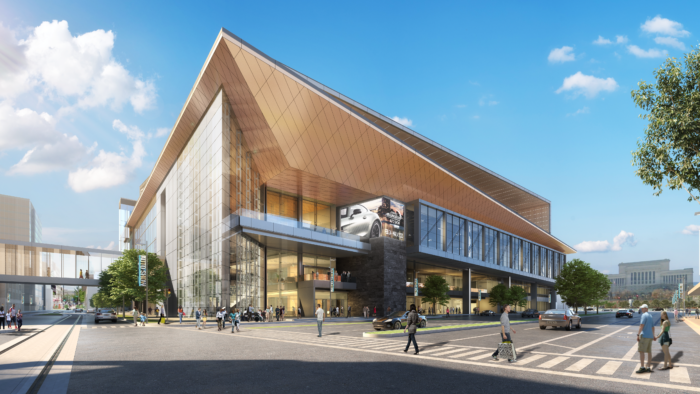 and CEO of the WCD. “Meetings and convention business acts as the economic foundation for hospitality and tourism in our region. I applaud the WCD Board and Governance Committee for the actions they have taken in the last two years and the trust they have placed in me and our team to lead the Wisconsin Center District toward Building More for the city we love.”
“When the Board authorized the expansion in April it was with the stipulation that final financing approval must come from the Governance Committee. The package which was approved today meets strategic financial goals including building the right facility to accommodate the WCD’s needs, and supporting the debt structure within the District’s restricted taxes. It also allows the WCD to construct a facility that will be an aesthetically compelling addition to the development and renaissance of Westown.”
By doubling the square footage of the convention center, the WCD will be able to host multiple, overlapping, and simultaneous events. The facility will emphasize flexible space arrangements which will meet the needs of meeting and event planners locally, nationally, and globally. Increased meeting and convention business will result in greater demand for downtown hotel room night usage, which will increase tax revenue and cause compression, driving visitors to neighboring communities. These visitors will patronize Milwaukee’s restaurants, bars and entertainment venues, boosting support industries.
Wisconsin Center District owns & operates the Wisconsin Center, UWM Panther Arena & Miller High Life Theatre.
“The WCD Board has invested countless hours over the last two years providing input and guidance on the expansion project,” said Jim Kanter, WCD Board Chairman. “From creating jobs to attracting visitors, this project sets our city up for immediate and future success. The WCD will serve as a sign of economic strength for the city of Milwaukee and join the rest of the development taking place west of the river. From ground-breaking to grand-opening, the expansion of the Wisconsin Center will be a real source of pride for all of Milwaukee.”
According to a study by third-party consulting firm, HVS, convention business will see 2019 booking numbers again in 2023, which means having a new facility open and available to book in 2024 will make Milwaukee an even more desirable destination.
“I am thankful for and applaud the WCD Governance Committee for approving the resolution today to support the bonds needed to build the Wisconsin Center expansion,” said Peggy Williams-Smith, president and CEO of VISIT Milwaukee. “This is an investment in the future of Milwaukee that is long overdue. We know that meetings and conventions will return, and we want to be assured that Milwaukee makes the short list when they do. We know that this is the time to set ourselves up for future success. Meeting planners are booking now for 2023 and beyond, and we want to position the Wisconsin Center as the newest and best convention space amongst our peer group.”
Additionally, the WCD is in the process of getting its Global Biorisk Advisory Council (GBAC) STAR accreditation, which is the cleaning industry’s only outbreak prevention response and recovery accreditation for facilities. GBAC-compliant features will be integrated into the building and include touchless designs, efficient HVAC systems, self-sanitizing escalator railings and more.
Sarah Maio is Vice President of Marketing and Communications for the Wisconsin Center District.
Pabst Theater Group and AXS Forge Exclusive Partnership
Pabst Theater Group (PTG) and AXS announced that they have entered into an exclusive ticketing partnership. The deal extends to all four of the venues in the Milwaukee-based company’s portfolio: The Pabst Theater, The Riverside Theater, Turner Hall Ballroom and The Backroom At Colectivo. PTG will utilize AXS’ state-of-the-art, wide-ranging solutions that cover every level of the event lifecycle, including the “Fansight” purchase flow with 3D maps for seat selection, integrated venue website by Carbonhouse, premium dynamic pricing solutions, the ”Fan Account” membership solution, paperless entry with AXS Mobile ID, “AXS Anywhere” with the AXS open distribution API, and more.
The AXS Platform allows PTG to operate its fast-paced business at scale, self-sufficiently but with the backing of AXS’  white glove client support team.
“Welcoming AXS as our exclusive partner is the next step in our commitment to an even greater ticketing experience for our customers,” said Gary Witt, CEO of Pabst Theater Group. “Between 3D seat maps, ease of use app compatibility and seamless ticket transfer options, AXS offers our customers a host of features that make the ticket buying process easier and more secure. From day one of The Pabst Theater Group, our focus has been on the customer experience and AXS is the next step in our continuing effort to make it the best it can be.”
 “Pabst Theater Group and AXS are coming into this partnership with identical goals,” added Dean DeWulf, Senior Vice President, Music Division, AXS Ticketing. “AXS is an excellent fit for music venues looking to maximize customer experience, distribution, revenue potential and data insights. We are incredibly proud to be partnering with Gary Witt, Matt Beringer and everyone at PTG as they continue their commitment to bring the best entertainment to the people of Milwaukee.”
The AXS Platform supports the entire event lifecycle starting with discovery and the AXS Anywhere API which allows for promotion and purchasing on major social media, streaming, and discovery sites such as YouTube, Spotify, Facebook, Songkick, and Bandsintown.
The purchase step begins with the new fully-integrated Pabst Theatre Group website by Carbonhouse, which connects automatically to the venue-branded “Fansight” purchase flow enabling 3D “view-from-seat”, premium dynamic pricing and upgrade offerings that ensure PTG can maximize ticketing gross potential and boost ancillary revenues.
AXS’ patented ID-based ticket delivery solution, “AXS Mobile ID,” powers seamless and secure paperless entry into the venues, ensuring that PTG knows who is attending their events and fans know their tickets are genuine.
Post-event, PTG can continue the fan relationship with the Fan Account membership platform, offering rewards and personalized offerings for future events.
The AXS platform also brings greater data insights and communication opportunities with customers, leading to augmented sponsorship opportunities and a constantly evolving user experience.
Levi’s® Stadium Transitioning to Cashless Venue to Enhance Fan Experience Upon Eventual Return of 49ers Fans
By 49ers.com
In keeping with the organization’s history as a leader in leveraging technological innovation to enhance the fan experience, the San Francisco 49ers announced that Levi’s® Stadium will be among the first wave of NFL venues to complete the transition to a cashless payment model whenever fans are able to return to the venue. The 49ers, while also announcing a multi-year partnership extension with its long-time official payments partner Visa, are making the move to only accept card or mobile payments for concessions, merchandise, and other purchases to improve the fan experience through increased speed of service, safety, and security.
Last year, the 49ers announced they would become the first team in global professional sports to include a dedicated menu

2019 San Francisco 49ers Season:
Playoffs: NFC Championship Game 2020
Green Bay Packers vs San Francisco 49ers
Sunday, January 19, 2020
Santa Clara, CA
(49ers Photo)
“While the move to fully cashless transactions in venues has advanced more quickly due to the ongoing health emergency, this is a direction we have been heading for several years and we know it’s one that will further improve the fan experience at Levi’s® Stadium,” said Al Guido, 49ers President. “Six years of operational data here at Levi’s® Stadium tells us that mobile payments are increasing while cash transactions decrease annually. And through our friends at Visa, we know contactless payments reduce transaction times, concessions lines, and some costs.”
In preparation for Super Bowl 50 at Levi’s® Stadium in 2016, the 49ers and Visa completed an overhaul to upgrade the venue’s concessions infrastructure to make it the first fully contactless enabled stadium in the NFL. With close to 600 contactless terminals around the stadium, fans can quickly pay without missing any on-field action.
For fans without any payment options other than cash, the 49ers are installing four on-site cash-to-card kiosks that will enable fans to exchange cash for a Visa-branded prepaid card, up to $100 with no transaction fee. Users will be able to swipe the prepaid card for payments inside and outside of the venue and check their balance anywhere, anytime at RCbalance.com. The cards are not reloadable. The kiosks feature English and Spanish language prompts and will be located at various locations inside the stadium security perimeter; locations to be announced at a later date.
“The 49ers offering a fully digital payment experience for each and every fan is a game changer. Whether buying at concessions in between plays or ordering from their seats, all fans will now be able to quickly and safely tap to pay, ultimately minimizing touchpoints at checkout,” said Mary Ann Reilly, senior vice president of North America Marketing, Visa. “Visa is happy to extend our partnership with the 49ers and provide the ultimate game experience whenever fans return.”
30|UNDER|30 Spotlight: Tim Demott
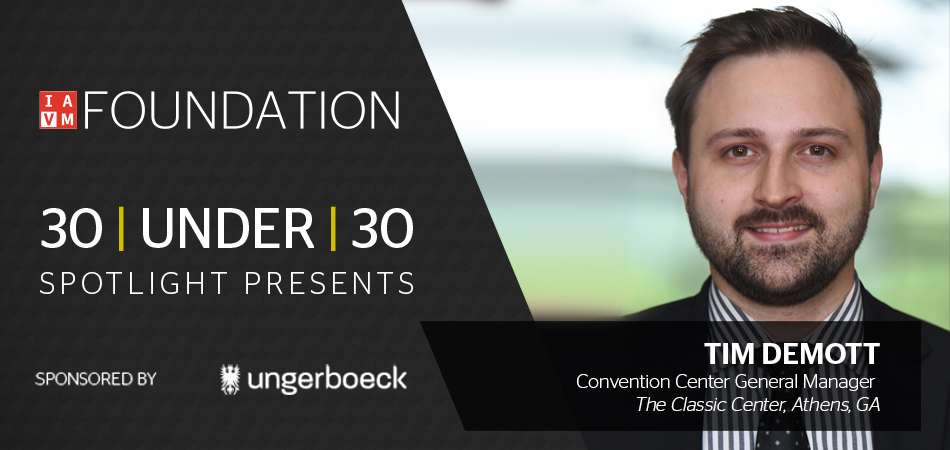
Tim Demott
General Manager of the Convention Center at The Classic Center
Tim DeMott is the General Manager of the Convention Center at The Classic Center in Athens, GA. Tim Graduated from the University of Georgia and started working with The Classic Center as a volunteer usher before coming on staff as an Event Planner. Once on the team full time, Tim quickly rose through the ranks, becoming the youngest Department Head in Classic Center history. He has a true passion for events and enjoys the challenge of logistics and planning while working tirelessly to exceed guests’ expectations.
Join your Foundation in congratulating Tim on being honored as one of the 30|UNDER|30 Class of 2020 and don’t forget to come back each Thursday as we spotlight another honoree!
100+ Women of IAVM Scholarship Application for VC20 Now Open

Thanks to the generosity of so many IAVM members, today’s the day we are able to open up application for five (5) women to be able to attend VenueConnect 2020 Virtual!
Criteria for the VC20 100+ Women Scholarship Application:
- Must be a woman employed or recently employed in the venue industry
- Must have an active professional or young professional membership with IAVM
- Must be unable to pay for VC20 registration due to being furloughed, laid-off or budget slashing related to the COVID-19 pandemic or related hardship
- Must apply before the deadline of October 16, 2020
CLICK HERE to apply now!
If you have yet to invest in the 100+ Women program, we are still happy to take your donation. Make today the day you decide to change the professional lives of women in our industry. Make your investment today!