



Wisconsin Center District Promotes Megan Seppmann to New Leadership Role
Following an award-winning expansion that has firmly established Milwaukee as a premier destination for major events, the Wisconsin Center District (WCD), owners and operators of Baird Center, Miller High Life Theatre and UW-Milwaukee Panther Arena, announces the promotion of Megan Seppmann to Vice President and Chief Commercial Officer (CCO).
“Megan has consistently shown strong leadership in our industry,” said Wisconsin Center District President and CEO Marty Brooks. “She has helped raise our profile for local and national events and has been a valuable contributor across our organization, offering a broad strategic perspective and supporting the modernization of our growing District.”
Since joining the WCD as Vice President of Sales in December 2018, Seppmann has been instrumental in positioning Baird Center on the national map. She helped spearhead efforts that brought in marquee events including the Republican National Convention, the Democratic National Convention and the 2024 Connect Marketplace. Her leadership has also helped drive Baird Center’s occupancy from below 40% to more than 85% today.
She has also established herself within the industry as a thought leader, strategic planner and expert in sustainability. Her reputation has earned her invitations to speak at top-tier industry events such as Informa Connect and IAEE’s Expo! Expo!, which Baird Center will host in 2026.
In this new role, Seppmann will lead strategic planning for the WCD’s long- and short- term plans alongside the President and CEO, develop dashboards, KPIs and performance metrics to measure results and inform decision-making across the organization while partnering with marketing, operations and event services to ensure seamless execution from sales to service delivery.
“This new position doesn’t just elevate my role—it reflects the District’s momentum as a polished, forward-thinking organization with its eyes firmly on the future,” Seppmann said. “We intentionally designed this role to grow alongside both the organization and the ever-evolving events industry, embracing the exciting, new opportunities that lie ahead for convention centers. I’m truly energized to help guide us forward as we continue to position Baird Center and this entire organization as a true force in the meetings, conventions and events industry.”
Seppmann will officially assume her new role on January 1, 2026.
When Welcoming Service Dogs: Everyone Has Rights, Everyone Has Responsibilities
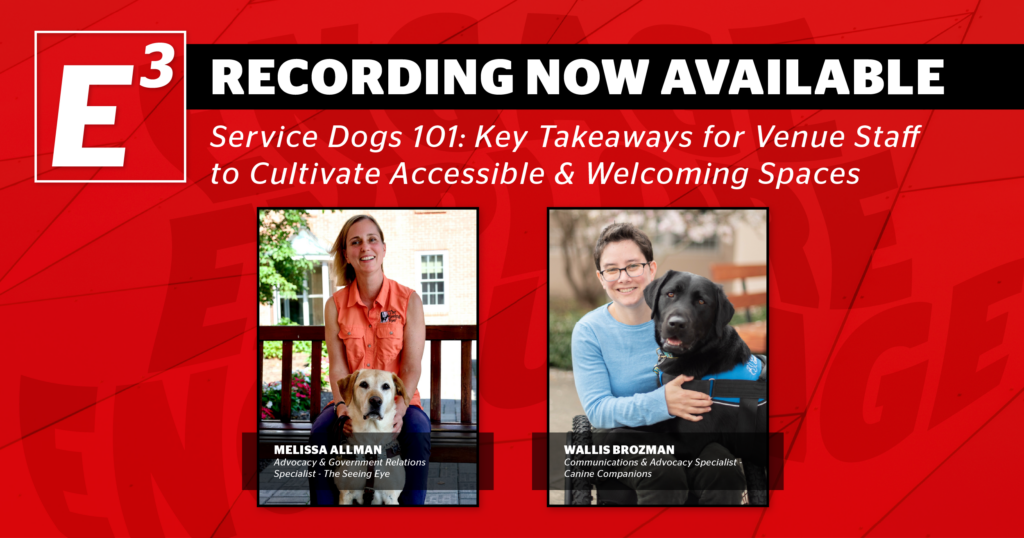
Common sense, mixed with compassion, goes a long way when complying with ADA rules regarding service animals in public assembly facilities.
Asked what to do when a historic theater with a limited seating footprint is faced with accommodating an oversized service animal, Wallis Brozman, Communications and Advocacy Specialist, Canine Companions, suggested making room, like providing two seats so the dog can lie on the floor at its handler’s feet, if circumstances permit. “That accommodation is not required,” she noted. “It’s just a general kindness to do that.”
Speaking at an IAVM’s Diversity and Inclusion Leadership Committee (DILC) E3 webinar, along with Melissa Allman, Advocacy and Government Relations Specialist, The Seeing Eye, Brozman has personal awareness of that situation, since her service dog is an “enormous” 75-pound Lab-Golden Retriever, which may require additional space.
There are common myths about what is required and not required when an attendee with a service animal shows up at an IAVM venue or any public space. “Service animals are specifically trained and tasked to mitigate their handler’s disability,” Brozman said. “Our service dogs must be trained to the disability.”
The definition of disability has been greatly expanded under federal ADA laws and might include training to detect changes in blood sugar and to give a seizure response. A person with a disability could be a veteran with PTSD or a child with autism. Basically, the laws apply to physical or mental impairments that substantially limit major life activities. “We serve over 65 known types of disabilities,” Brozman said.
It’s important to realize service dogs for veterans with PTSD, for example, are not therapy dogs. They are trained to a task, perhaps to physically interrupt flashbacks.
“It’s fairly obvious I’m blind, and seeing is a major life activity,” Allman added. When the disability is not visible, allowing service animals to accompany the disabled into a venue becomes more challenging. Since 2010, the law has been clear on what can legally be asked to verify the legitimacy of the service animal.
You can ask two questions:
° Is this a service animal needed because of a disability?
° What task is it trained to perform?
“Venues need to remember it’s not one-sided,” Allman said. People with disabilities, in general, have a right to be accompanied by a service animal wherever the public is allowed to go, but that animal must be trained to a physical task.
Do not ask to see some identification as proof this is a service animal, Allman added. No such documentation is required, and you’re not allowed to ask. “There are plenty of websites that will ‘certify’ your service dog,” Brozman said. That is a common misconception.
Service animals do not have to wear vests, either. “Anyone can put a vest on a dog, but that does not make it a service dog,” Allman said.
It is required that the person with a disability always maintains control of their service animal. It must be leashed or tethered at all times, unless doing so would interfere with the task — for example, if the dog needs to retrieve an object.
There could be situations where the presence of a service dog interferes with the business, such as at a zoo if dogs are natural predators of the animal on exhibit. Then they could be excluded. If the service dog is disruptive to others or to the event, the host can ask the disabled to remove the dog and come back without their dog.
Behavior is the barometer. Venues do have rights, but one needs to discern whether it’s misbehavior on the dog’s part or the task they’re trained to. A dog could be trained to bark once as a call for help.
“Any dog that is showing aggressive behavior can be excluded from a venue,” Brozman said. “Aggression is never permitted. Don’t go on looks; it’s the behavior of the dog which determines whether it should be there and could be there.”
However, it is illegal to exclude a service animal due to allergies or fear of dogs on the part of other patrons. “If someone’s allergy rises to the level of a disability, both individuals need to be reasonably accommodated,” Allman said.
The disabled do not have to disclose ahead of time that they will be bringing a service animal to a performance nor is it legal to ask a patron with a disability dining at a restaurant to sit outside because dogs on premises are unsanitary. It is also illegal to charge additional fees because a person is accompanied by a service animal, which is sometimes incorrectly requested by hotels.
Essentially, a service dog is Durable Medical Equipment (DME), like a wheelchair, and no one would consider charging an additional fee “because I brought in wet tires,” she said, likening that to a muddy pawprint. “I am responsible if my dog chews on the corner of a couch — anything beyond normal wear and tear.”
Service dogs are not emotional support animals. Those animals, such as an alligator named Wally, have often made headlines, but the only place they are legally allowed is in housing where pets are normally banned. Emotional support animals and therapy dogs do not have carte blanche to attend events in public places, Brozman said. The handler of such animals is not disabled and those animals are not task-trained to mitigate a disability.
Brozman and Allman were adamant that service dog fraud is not victimless. Brozman’s previous service dog was attacked by alleged service dogs, fraud dogs, in public places to the point he developed severe hyper vigilance and had to be retired at age four. In the U.S., a survey showed 93 percent of service dog users encountered out-of-control dogs falsely claimed as service animals in public places. There is intentional fraud and unintentional fraud in the industry; either way it’s expensive emotionally and fiscally. Her program spends $50,000 training one dog for service.
During the webinar, which was moderated by DILC committee member Katherine Foster, assistant operations manager, Mayo Performing Arts Center, Morristown, N.J., more than 42 questions were logged. Foster promised to get back to those people when time expired and added her own pitch to venue managers to consider providing training opportunities for service puppies. “Invite them to come in and practice maneuvering through crowds,” she urged, noting they do that at her venue, and it’s educational to the staff as well as to the service dog, resulting in an accessible and welcoming environment.
A record 419 people registered for this E3 webinar, according to Amy Fitzpatrick, MPA, IAVM director of marketing. A recording of the webinar and collateral materials are available here – https://youtu.be/216mnvBO2ys.
Fitzpatrick also promoted supporting the DILC’s Dollars for Diversity campaign, “an initiative which directly fuels programs and scholarships that empower underrepresented voices, expand access to education, and strengthen our collective ability to create inclusive venues.” To donate to the campaign, click here – https://member.iavm.org/cv5/cgi-bin/memberdll.dll/info?wrp=donationnew.htm&subscriptionname=DON_DIVERSITY
Proctors Collaborative Welcomes Marisa Flynn as Vice President of Programming, Marketing, and Communications
Proctors Collaborative proudly announces the appointment of Marisa Flynn as its new Vice President of Programming, Marketing, and Communications. Flynn brings nearly two decades of experience in entertainment, brand leadership, and business development to one of the Capital Region’s leading arts organizations.
Flynn joins Proctors Collaborative following her role as Vice President of Business Development at the Oak View Group, where she led efforts to grow partnerships and uncover new revenue driving and guest experiential opportunities across arenas, performing arts centers, colleges, and cultural attractions. Her deep roots in the live entertainment industry include her time as a producer and as the Director of Booking at Mills Entertainment, where she worked closely with artists, agencies, and venues to bring innovative live experiences to audiences across the country. Flynn also served as the Brand Director for “The World’s Most Famous Delicatessen, Carnegie Deli” where she spearheaded the development and successful launch of its food service and retail product lines.
As Vice President, Flynn will oversee the organization’s programming strategy following Jean Leonard, who served in that capacity before becoming President of Proctors Collaborative. Flynn will lead efforts to strengthen the Collaborative’s presence across its venues — Proctors in Schenectady, Capital Repertory Theatre in Albany, and Universal Preservation Hall in Saratoga Springs — and expand its commitment to bringing world-class performances, community engagement, and arts education to the Capital Region.
“Marisa’s combination of creative vision and leadership experience makes her a tremendous addition to our team,” said Leonard. “Her national perspective and deep connection to the Capital Region will help us build on our mission to create inspiring, accessible, and transformative arts experiences.”
“Proctors has been an important part of my professional journey and personal life, so stepping into this role is truly an honor. I look forward to being a part of this incredible team to grow audiences, elevate our programming, and continue Proctors Collaborative’s legacy as a cultural cornerstone,” said Flynn.
Flynn holds a B.A. from Penn State University and is widely recognized as a leader in the live entertainment industry, having served as a panelist, moderator, and mentor through the International Association of Venue Managers, Florida Venue Managers Association, and VenuesNow Conference. She most recently served as Vice Chair of IAVM’s Allied Committee, received her Certified Venue Professional certification through IAVM and has been honored with the Paul Harris Fellow Award from Rotary International for her community service here in the Capital Region.
Des Moines Performing Arts Taps Emmy-winning Kennedy Center Leader Monica Holt as New CEO
Des Moines Performing Arts (DMPA) announced Monday that Monica Holt, a nationally recognized arts leader and former senior vice president of artistic planning at The John F. Kennedy Center for the Performing Arts, will serve as its next president and chief executive officer.
Holt will step into the role in January 2026, following the retirement of longtime CEO Jeff Chelesvig, who will conclude his 30-year tenure later this month.
DMPA oversees the Des Moines Civic Center, the Temple Theater, the Stoner Theater and the outdoor Cowles Commons space. Holt joins the nonprofit after 16 years with The Kennedy Center, where she oversaw a budget of more than $110 million and programming for more than 2,000 events each year.
She helped lead major audience and revenue growth initiatives and “championed the essential role performing arts centers play in fostering community wellbeing,” according to a news release.
Before that, she served as the center’s director of marketing, where she led audience engagement efforts for the Kennedy Center, Washington National Opera and National Symphony Orchestra.
Holt’s appointment comes at a time of transition for The Kennedy Center, which saw major leadership shifts earlier this year under the new board chair, President Donald Trump, following the firing of longtime president Deborah Rutter and the replacement of several board members.
In a farewell statement on LinkedIn a few months later, Holt wrote that she decided to leave the center after 16 years, telling her colleagues that “creativity flourishes best when community thrives alongside it.”
Chelesvig, who retires Nov. 21, leaves behind a legacy that helped transform Des Moines into a destination for top-tier theater. Under his leadership, DMPA launched the Willis Broadway Series and the High School Musical Theater Awards, and restored the Temple Theater.
Longtime Vice President and Chief Financial Officer Heidi Watkins will serve as interim president and CEO until Holt officially assumes the role in the new year.
Source: Iowa Public Radio
Justin Horwitz Named New Senior Director of Sales of The Jacob K. Javits Convention Center
New York Convention Center Operating Corporation (NYCCOC), which oversees the Jacob K. Javits Convention Center, announced today that Justin Horwitz has joined the organization as the new Senior Director of Sales.
In his new role, Horwitz will be responsible for providing leadership, direction and guidance to the Sales team. Through effective relationship building, account management and strategic partnerships, Horwitz will generate new business and drive revenue growth while significantly contributing to Javits Center’s mission to drive economic impact of the City and State of New York.
“I’m thrilled to be joining the dynamic Sales team that brings the top events in the world to Javits Center,” said Horwitz. “I’ve spent most of my career selling the innovation and energy of New York, and being able to do it on the scale of Javits Center is a dream come true.”
Horwitz brings 14 years of hospitality and events sales experience to Javits Center. Most recently, he worked as the Citywide Sales Executive for Marriott International where he oversaw the citywide sales strategy for seven major hotels in New York City. Prior to his role at Marriott International, he worked at Cvent as a Senior Account Manager and at Marriott International in the New York, San Diego and Philadelphia markets. He graduated from the University of Delaware.
“We’re excited to expand our Sales Team as we begin to reimagine our sales strategy at Javits Center,” said Joyce Leveston, Javits Center’s President and Chief Executive Officer. “The talent here at Javits Center has been exceptional and people are the heart of what we do here – I believe Justin will be an excellent addition as we continue to find new ways to enhance the customer experience at Javits Center.”
“With his extensive experience within the hotel and hospitality industry, I’m confident that Justin will bring a fresh perspective to our team as we look for new ways to drive revenue,” said Ronnie Burt, Chief Revenue Officer of Javits Center. “I look forward to seeing what we can all achieve together as we bring Javits Center into the next era of excellence.”